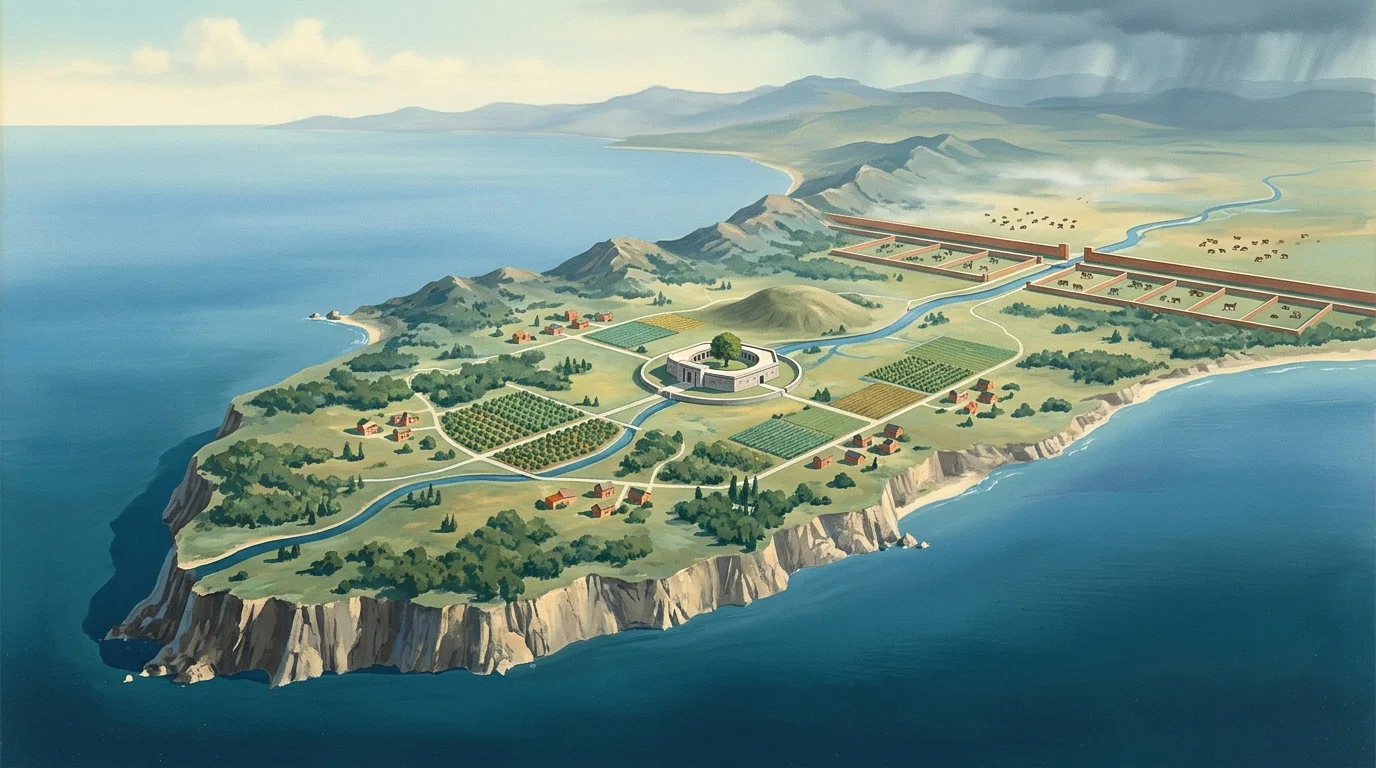
The Garden of Eden on its Mediterranean peninsula
Plate 10 of 13 · The Plates of Urantia Wiki
Depicts
Used in
Sources
Painted from these passages. Hover a reference to read it.
Accuracy record
Specified by the text
- A long narrow peninsula, almost an island, projecting westward from the eastern shores of the Mediterranean (73:3.1); now submerged under the eastern Mediterranean (78:7.7)
- Encircling mountains; rain falls copiously on the surrounding highlands but seldom in Eden; each night a mist rises from the irrigation network (73:3.3)
- Coastline considerably elevated; the neck joining the mainland only 27 miles wide at its narrowest (73:3.4)
- A great river comes down from the peninsula's higher lands and flows east through the neck to the mainland and across Mesopotamian lowlands; fed by four tributaries rising in the coastal hills (73:3.4)
- Mountains rich in precious stones and metals, largely ignored (73:3.5)
- Only birds and domesticated species in the park; pasturage and herds on the mainland; no animals slaughtered in it (73:4.1)
- A brick wall across the neck; a smaller wall just outside it with a zoo of wild beasts between, in twelve divisions, walled paths to twelve gates, the river and pastures in the central area (73:4.2-4.3)
- Stone temple of the Father at the center; administration to the north; workers' homes to the south; schools to the west; Adam's domiciles in the 'east of Eden'; planned for a million people (73:5.1)
- At Adam's arrival one-fourth finished: thousands of miles of irrigation ditches, over 12,000 miles of paved paths and roads, just over 5,000 brick buildings, no cluster larger than seven houses (73:5.2)
- About five per cent highly cultivated, fifteen per cent partly, the rest left more or less natural (73:5.6)
- The tree of life grew in a central, circular courtyard of the temple (73:6.6)
- Adam and Eve viewed the Garden from the air on fandors, the large passenger birds (74:3.4); 37,848 years before A.D. 1934 (74:0.1)
Interpreted
- Seen from high above the western part of the peninsula looking east, a fandor's-eye view, so the peninsula, neck, walls and mainland read in one frame
- Buildings small and scattered in clusters of up to seven among mostly natural land
Invented for the picture
- Exact coastline shape, mountain profiles, the temple's form, vegetation species
Generated with gemini-3.1-flash-image from a brief written against the cited paragraphs.