Dalamatia, city of the Planetary Prince
Plate 9 of 13 · The Plates of Urantia Wiki
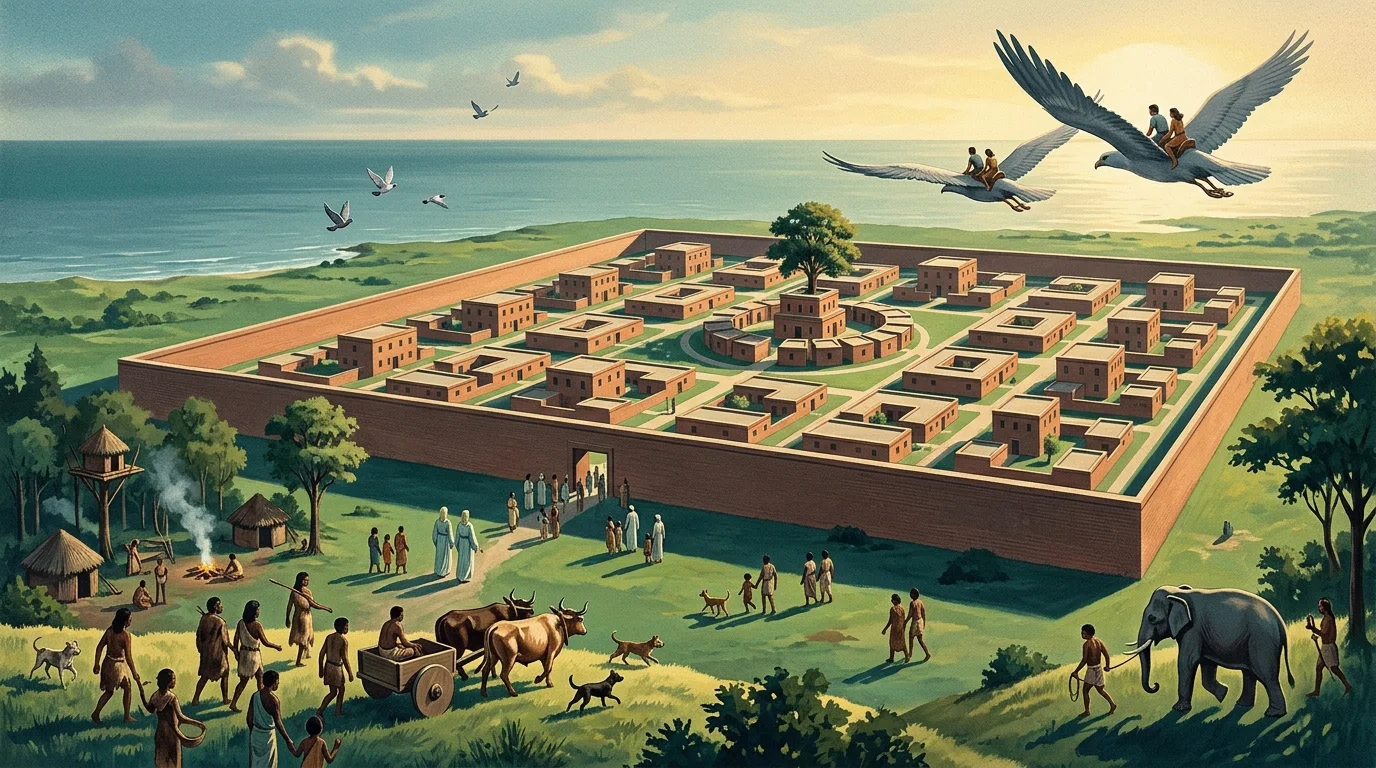
Depicts
Sources
Painted from these passages. Hover a reference to read it.
Accuracy record
Specified by the text
- About 500,000 years ago, headquarters in Mesopotamia, about the center of world population (66:0.2)
- Situated in the Persian Gulf region, in the district of later Mesopotamia; climate and landscape very favorable (66:3.1-3.2)
- A very simple but beautiful city enclosed within a wall forty feet high (66:3.3)
- Laid out in ten subdivisions with the council headquarters at their centers; centermost the temple of the unseen Father, with the Prince's administration in twelve chambers grouped immediately about it (66:3.4)
- All buildings one story except the council headquarters (two stories) and the central temple, small but three stories (66:3.5)
- Built of brick; very little stone or wood (66:3.6)
- All colors and strata of human beings lived near by (66:3.7); outside the walls people lived in tree dwellings, stone huts and kept night fires against beasts (66:5.8)
- Cattle bred for milk, oxen used for burden; the dog long domesticated; the blue man had tamed the elephant; the wheel newly taught; the horse NOT yet domesticated (66:5.5)
- Carrier pigeons first used; great fandors trained as passenger birds (66:5.6); skins and later weaving for clothing (66:5.2)
- The tree of life grew in the central, circular courtyard of the Father's temple (73:6.5)
- The midway creatures were invisible to humans (66:4.11)
- Later swept by a tidal wave and sunk beneath the sea; vestiges lie under the Persian Gulf (67:5.4, 78:7.7)
Interpreted
- City placed on a low coastal plain near the sea, since it was later overwhelmed by a tidal wave and lies under the Gulf
- Surrounding tribes shown with subtly varied skin tones (the Sangik colored races), in skins and simple woven cloth
- Brick architecture plain and well proportioned, not Babylonian ziggurats (500,000 years predates all known cities)
Invented for the picture
- Exact plan geometry, colours of brick and plaster, the vegetation, the appearance of fandors, the staff's dress
Generated with gemini-3.1-flash-image from a brief written against the cited paragraphs.