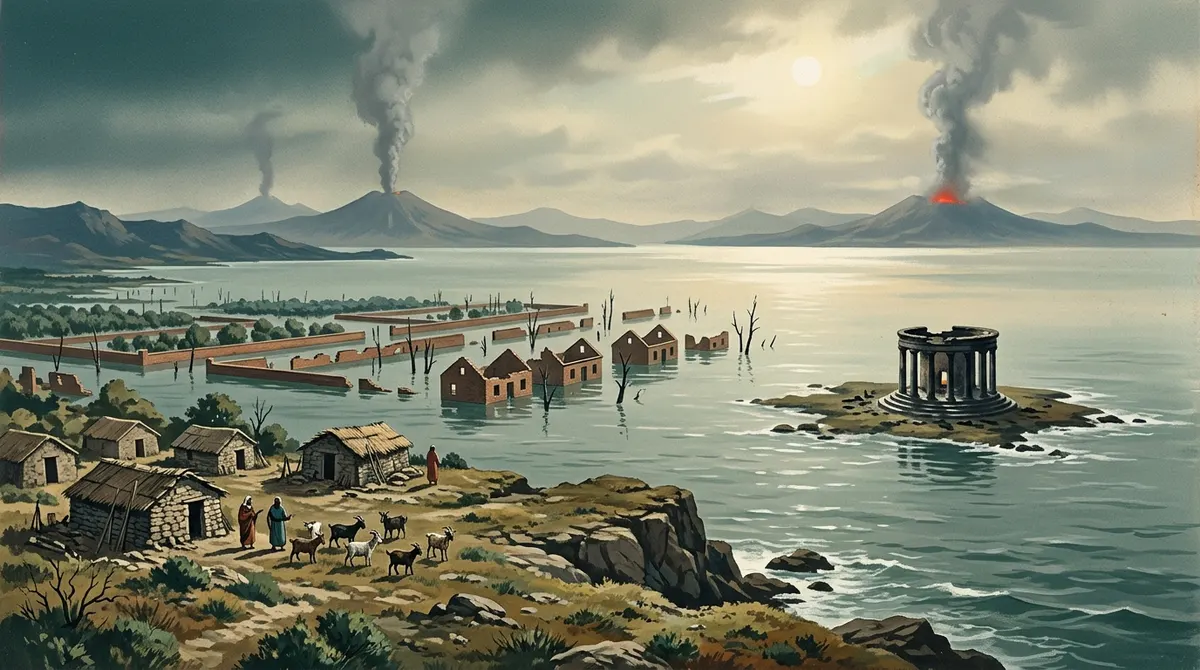
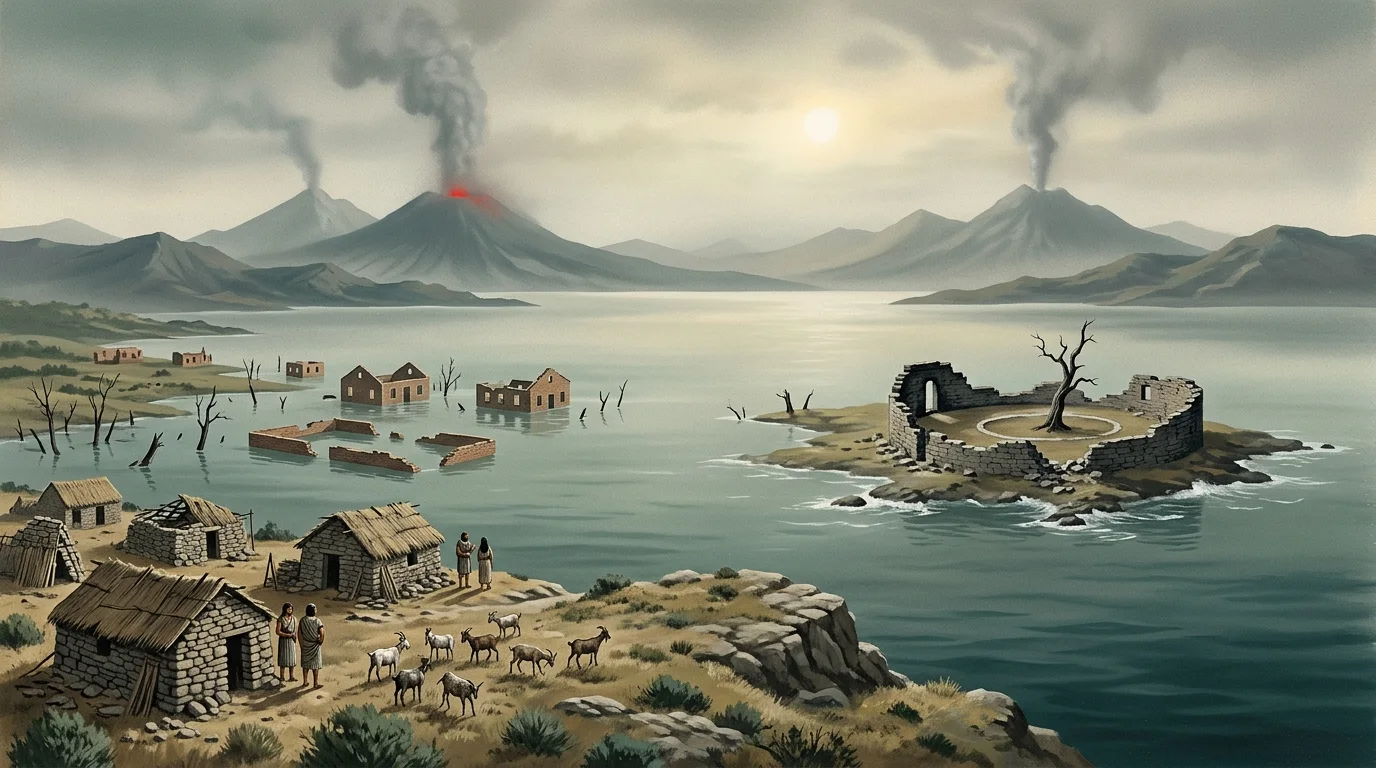
The Edenic peninsula sinks beneath the Mediterranean
Plate 38 of 120 · The Plates of Urantia Wiki
Depicts
Used in
Sources
Painted from these passages. Hover a reference to read it.
Accuracy record
Specified by the text
- After Adam left, the peninsula was occupied by Nodites and others for almost four thousand years (73:7.1)
- With violent activity of the surrounding volcanoes and the submergence of the Sicilian land bridge to Africa, the eastern Mediterranean floor sank, carrying the whole peninsula under; the coast line of the eastern Mediterranean was greatly elevated (73:7.1)
- The sinking was not sudden; it took several hundred years (73:7.1); the book calls it a natural occurrence (73:7.2)
- The Garden was a peninsula ringed by mountains in an inland sea (73:3.1, 73:3.3); a brick wall crossed its neck (73:4.2)
- The temple and the tree were destroyed by fire in one of the Nodite wars; 'only the stone wall stood until the Garden was subsequently submerged' (73:6.7)
- The temple was an exquisite stone temple at the centre of the peninsula (73:5.1), the tree growing in its central, circular courtyard (73:6.6)
- The Garden had a little over five thousand simple but artistic brick buildings, never more than seven houses in a cluster (73:5.2)
Interpreted
- One moment in the slow submergence: the sea already over the lowlands, ruins of Eden's brick buildings standing in the shallows
- Roughly 34,000 years ago
Invented for the picture
- The exact coastline, the settlement on the remaining high ground, the weather, the shape of the temple's wall (the text gives only a stone temple with a circular courtyard)
Generated with gemini-3.1-flash-image from a brief written against the cited paragraphs.
All versions
Every painting generated for this plate, newest first, including the ones that were set aside. Each was checked against the cited text; where one was replaced for an accuracy problem, the reason is given.