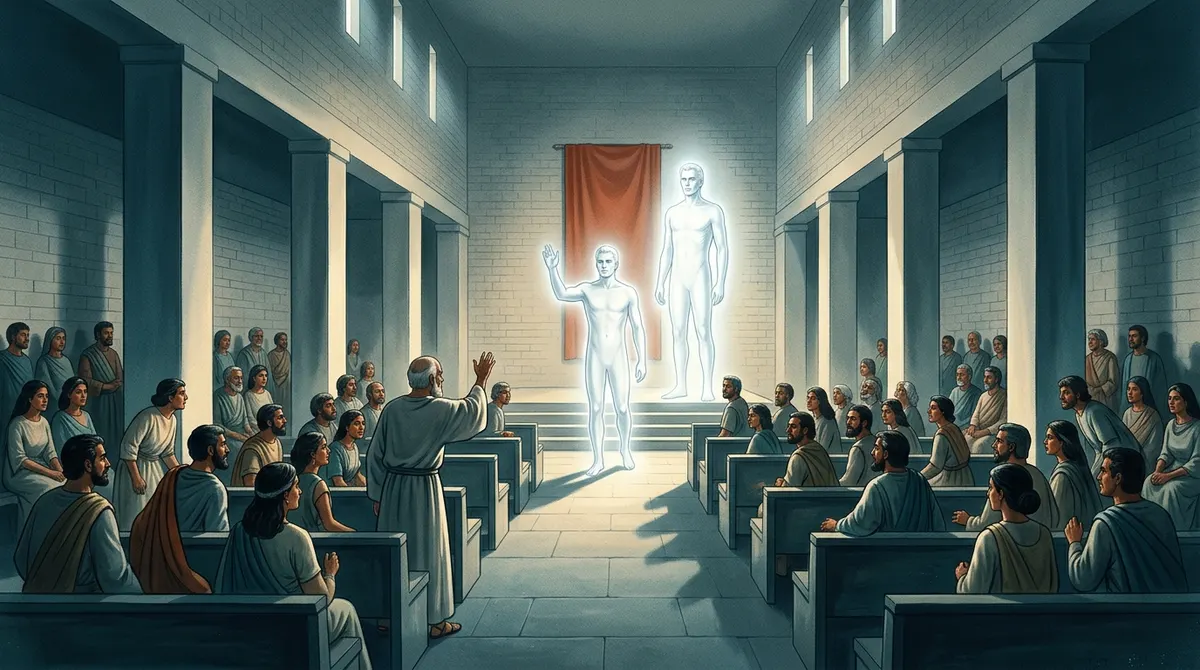
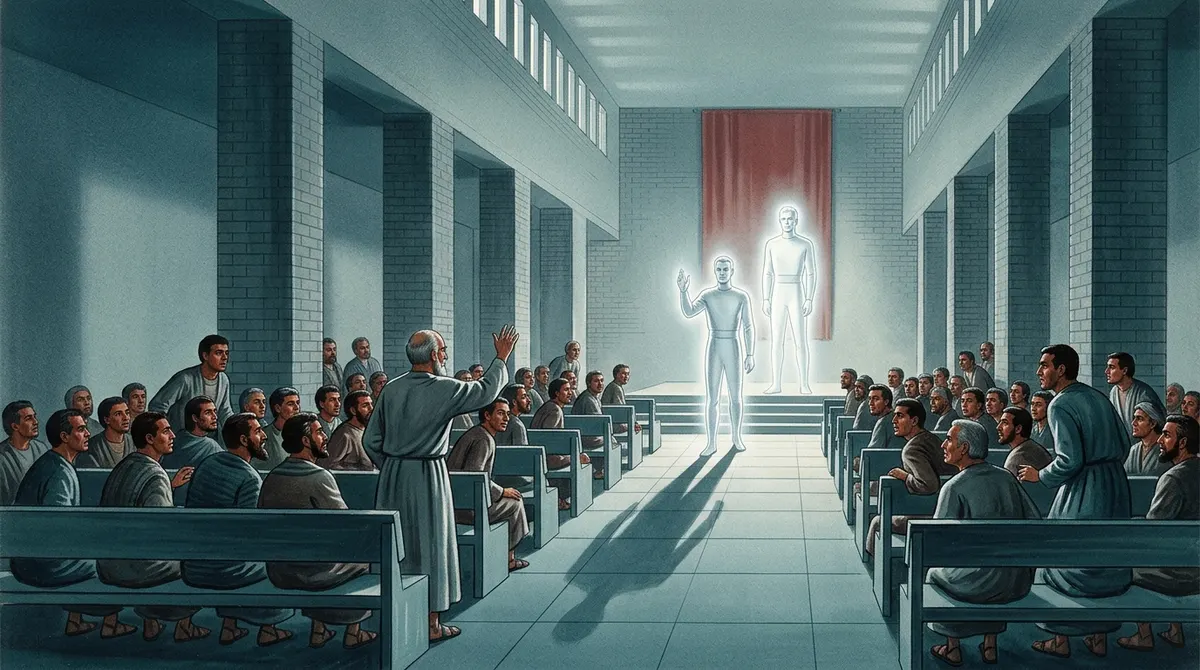
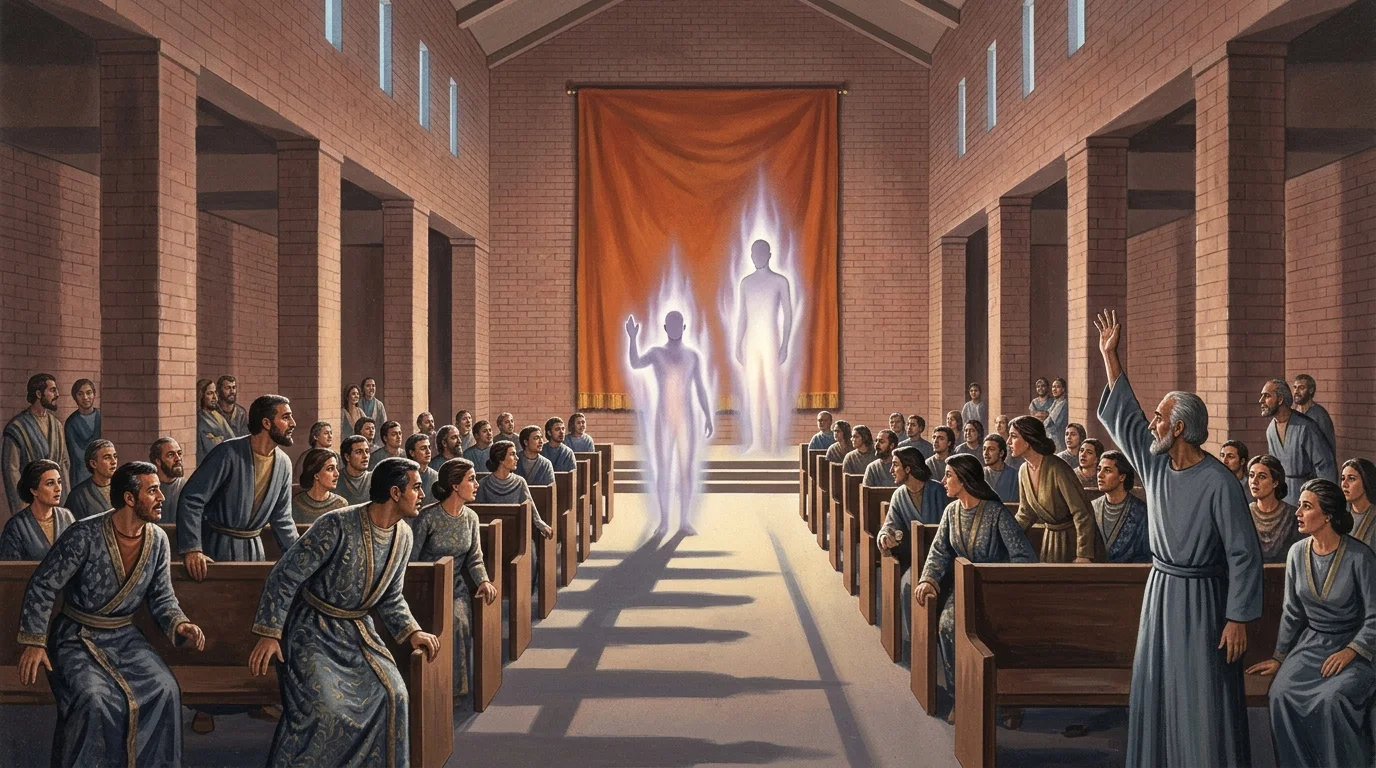
Daligastia proclaims Caligastia sovereign of Urantia
Plate 34 of 120 · The Plates of Urantia Wiki
Depicts
Used in
Sources
Painted from these passages. Hover a reference to read it.
Accuracy record
Specified by the text
- Caligastia was a Lanonandek Son of the secondary order (66:1.1); his associate Daligastia was also a secondary Lanonandek (66:2.2)
- Midwinter of the northern continents, about 200,000 years ago: after a long conference with Caligastia, Daligastia called the ten councils into extraordinary session and announced that the Prince would proclaim himself absolute sovereign, demanding they resign their powers (67:2.1)
- Van, chairman of the supreme council of co-ordination, called this rebellion and won the support of the entire staff; he later gave a seven-hour address indicting Daligastia, Caligastia and Lucifer (67:2.2)
- Daligastia formally proclaimed Caligastia 'God of Urantia and supreme over all' (67:2.4)
- Dalamatia: a simple but beautiful city within a forty-foot wall; at its centre the temple of the unseen Father, with the Prince's administrative headquarters in twelve chambers around it (66:3.3-4)
- Midway creatures were visible to the staff but not to ordinary humans (66:4.10)
- The book identifies Caligastia as 'the devil' of tradition (53:1.4)
- NOT GIVEN: what Caligastia or Daligastia looked like
- The corporeal staff were one hundred, fifty men and fifty women (66:4.2), in bodies carrying Andonite germ plasm (66:2.7)
Interpreted
- Caligastia and Daligastia drawn as radiant celestial personalities, tall humanlike forms of cold silver-white light, NOT horned devils: the text says what they were, not how they looked
- Like the midwayers, they are visible to the corporeal staff, though never to ordinary men
- Rebellion-era colour: colder, harder light than other plates
- Two moments are combined: the extraordinary session where Daligastia demanded abdication and Van protested (67:2.1-2.2), and the later formal proclamation of Caligastia as 'God of Urantia' (67:2.4)
Invented for the picture
- Caligastia's presence in the hall (the text names only Daligastia as addressing the councils)
- Their forms and features; the council chamber's architecture; the staff's faces; Van's age
- Known flaw in this painting: Daligastia and Caligastia read as smooth, glowing full-body silhouettes with arms and legs, more body-like than the canon's undefined outline, though faceless and unclothed.
Generated with gemini-3.1-flash-image from a brief written against the cited paragraphs.
All versions
Every painting generated for this plate, newest first, including the ones that were set aside. Each was checked against the cited text; where one was replaced for an accuracy problem, the reason is given.