The quarrel over Bablot's tower
Plate 29 of 120 · The Plates of Urantia Wiki
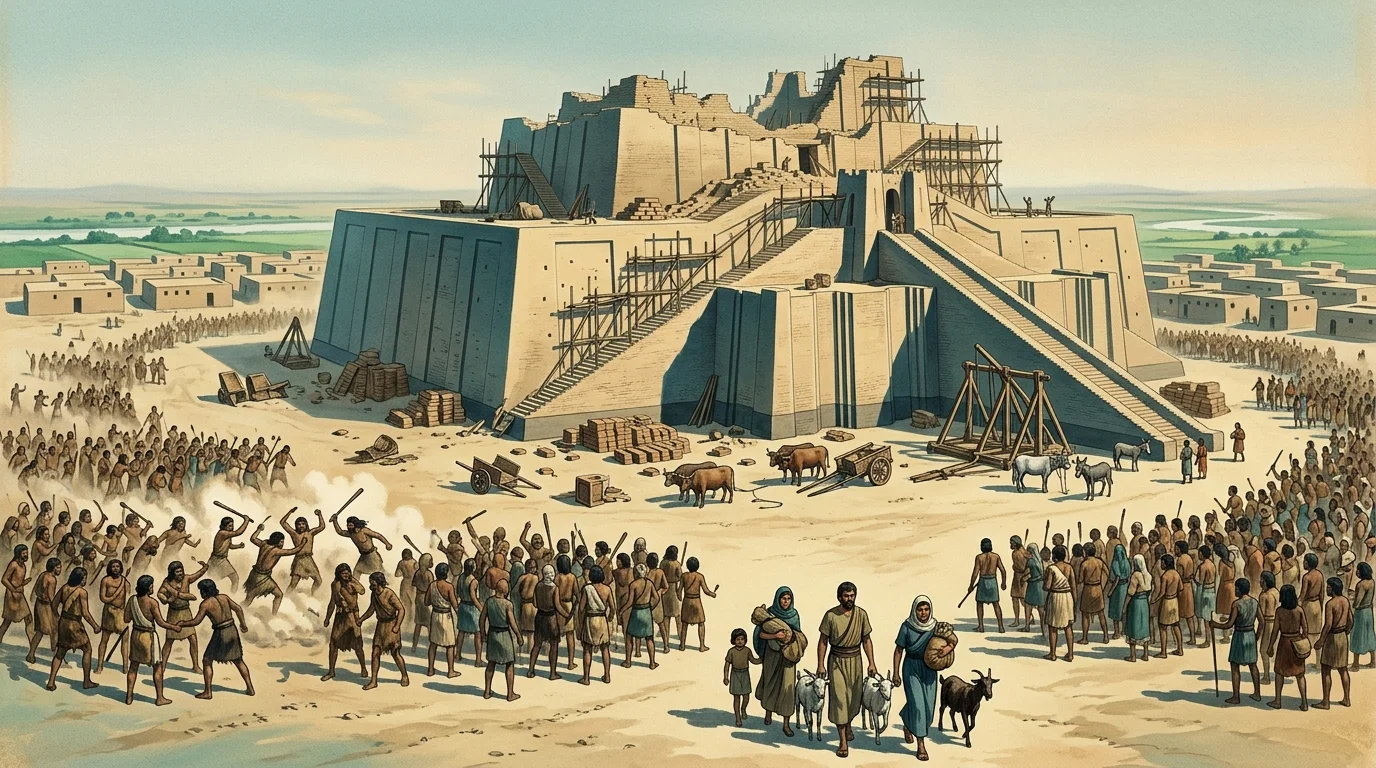
Depicts
Used in
Sources
Painted from these passages. Hover a reference to read it.
Accuracy record
Specified by the text
- About fifty thousand years after Nod's death the Nodites, too numerous for the lands around Dilmun, endorsed Bablot's plan for a temple of racial glorification with a tower the like of which the world had never seen (77:3.1-3.2)
- Built at the center of their territory, a safe distance from the sea; the city was named Bablot, later Babel (77:3.2-3.3)
- After four and one-half years of work a great dispute stopped all work; food carriers spread the news and large numbers of tribesmen gathered at the site (77:3.4)
- Three factions: a memorial of Nodite superiority (almost half), a monument to Dilmun culture, and a small religious minority wanting it dedicated to the Father as atonement (77:3.5-3.7)
- The religionists were voted down and fled south; the rest fought until well-nigh obliterated (77:3.8)
- Nodites had mixed freely with the Sangik races (73:1.6)
Interpreted
- Date roughly 160,000 years ago or earlier: Nodite culture declined for over 120,000 years after the Bablot conflict until Adam's arrival about 38,000 years ago (77:4.1), and the rebellion was 200,000 years ago (61:7.8)
- Built of mud brick, following Dalamatia's brick tradition (66:3.6) and the plain of later Babel
- Tower shown half finished as a broad stepped brick core with scaffolding and ramps
- The moment the debate turns to violence: the religious minority walking away south in the foreground
- Oxen and solid-wheeled carts for hauling; NO horses, which the book places much later (66:5.5)
Invented for the picture
- The tower's shape and height, the scaffolding, clothing, weapons (clubs and staves), the crowd's arrangement
Generated with gemini-3.1-flash-image from a brief written against the cited paragraphs.