An Andonite camp on the Somme
Plate 24 of 120 · The Plates of Urantia Wiki
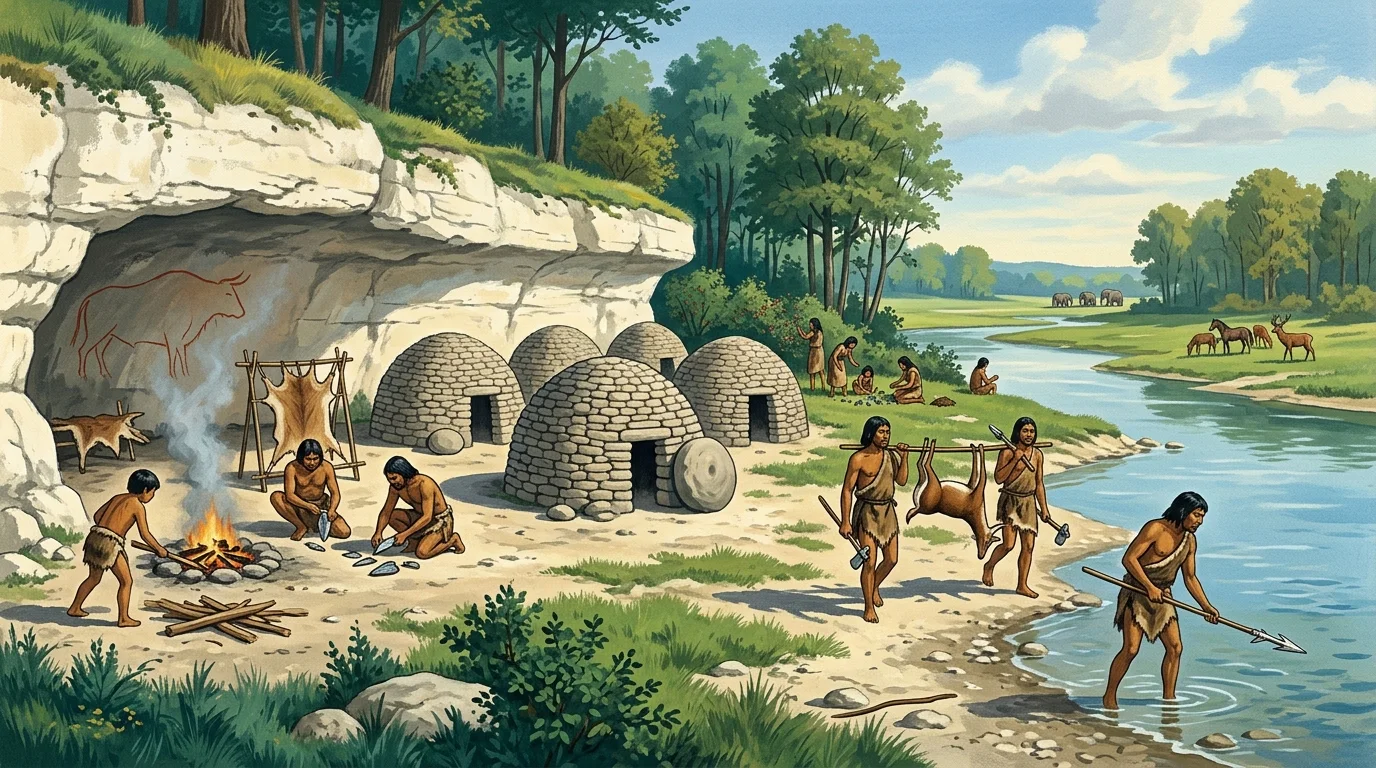
Depicts
Used in
Sources
Painted from these passages. Hover a reference to read it.
Accuracy record
Specified by the text
- Andonite tribes were the early river dwellers of France and lived along the Somme for tens of thousands of years; the Somme ran to the sea much as it does today (63:5.3)
- More than a thousand settlements along the great rivers leading to the then warm North Sea, before the third glacier reached France (63:5.1-5.2); England was joined to France by land (64:1.5)
- They lived under overhanging cliffs along rivers and in hillside grottoes with a good view, near a forest edge and beside a stream; not really cave dwellers (63:5.4)
- Dome-shaped stone sleeping huts, entered by crawling, the doorway closed by rolling a large stone kept inside (63:5.5)
- Fearless hunters living almost wholly on flesh plus wild berries and fruit; stone ax, throwing stick and harpoon; skilled flint workers (63:5.6)
- Clan hunted in groups and stayed near the homesite (63:3.3)
- Black eyes, swarthy yellow-red complexion, Eskimo-like appearance, skins for clothing (63:4.1)
- Crude outlines of venerated animals drawn on rock walls (63:6.3)
- In this era Europe had many deer, elephants, hippopotamuses, cattle, horses and wolves (64:4.2, dated 800,000 years ago)
Interpreted
- Late afternoon in a mild season, since the ice had not yet reached France
- Wild horses and deer shown only as distant game on the far bank; NO domesticated animals of any kind
- Chalk cliffs, as found along the Somme valley today
- No spears or bows: the book credits the spear to the later blue man and the bow to the red man (64:6.21, 64:6.4)
Invented for the picture
- Specific faces, hair and ornaments, the hut count and layout, the drawn animal, vegetation species
Generated with gemini-3.1-flash-image from a brief written against the cited paragraphs.