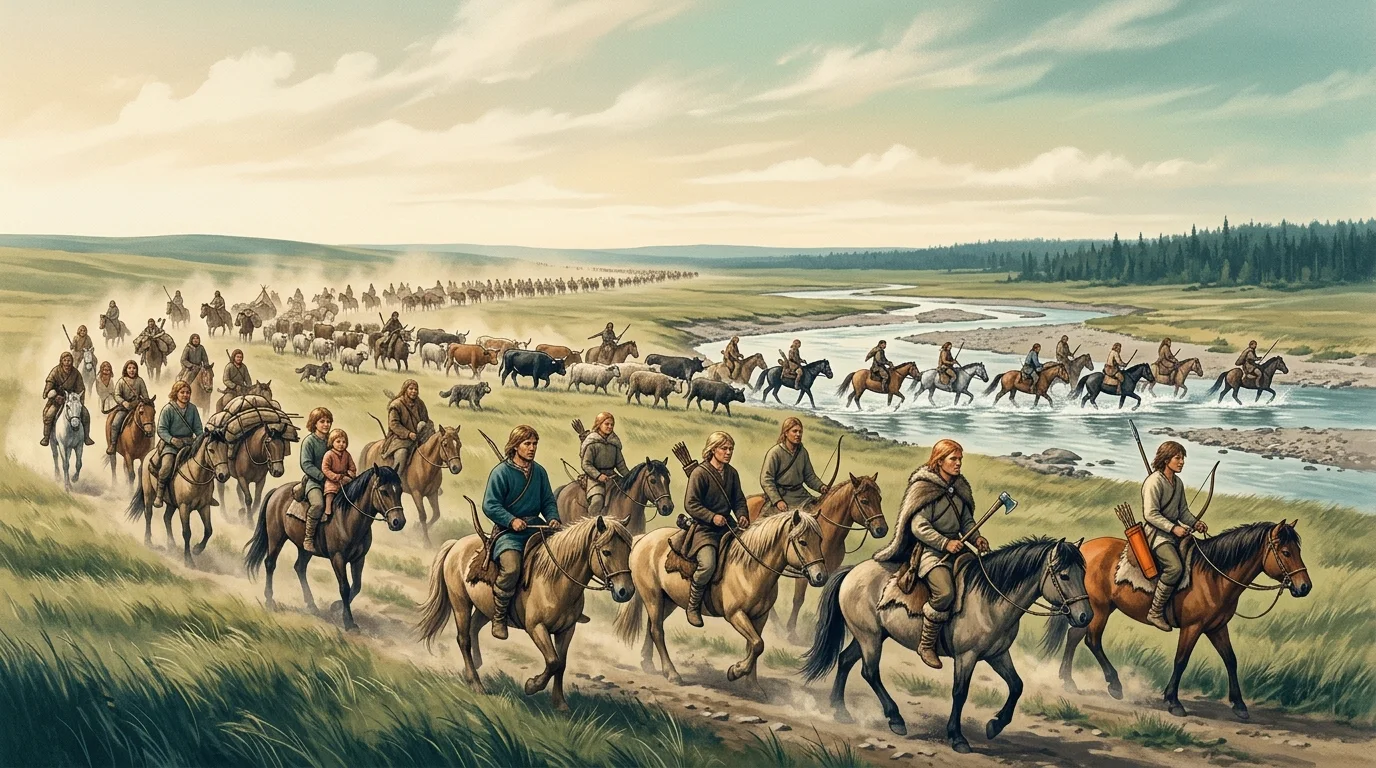
Andite horsemen crossing the Volga grasslands
Plate 21 of 120 · The Plates of Urantia Wiki
Depicts
Used in
Sources
Painted from these passages. Hover a reference to read it.
Accuracy record
Specified by the text
- Seven major Andite invasions of Europe, the last arriving on horseback in three great waves; most of the earlier and purer strains took the northern route across the grazing lands of the Volga and the Don (80:4.1)
- The horse gave the last Andite cavalrymen mobility to move quickly around the Caspian and reach Europe as coherent groups (80:4.4)
- The hard-riding Andite horsemen appeared in the sixth and seventh millenniums B.C., moving west across the Russian plains (80:4.5)
- The Andites of Turkestan were the first to domesticate the horse extensively (81:2.12)
- Andites were long-headed (81:4.2); 'not white... pre-white' (78:4.4); blond Andite types are recorded in central Asia (79:1.8); their descendants the early Nordics were long-headed, tall and blond (80:9.2)
- Militarily skilled and increasingly given to conquest (78:4.5)
- European grazing lands were being overtaken by forest as the rain winds shifted north, from about 15,000 years ago (80:3.8)
Interpreted
- A wide panorama of riders with their families and herds moving west across open steppe, a river crossing in the middle distance
- Skin tones from light olive to fair, hair from brown to blond and red, to show a blended people becoming 'pre-white' rather than uniformly Nordic
- Small, stocky early domestic horses ridden bareback or on hide pads, since saddles are not mentioned
- A dark forest edge on the far northern horizon to echo the spreading forests
Invented for the picture
- Clothing, weapons (bows, spears, stone and copper axes), the horses' colours, the wagons, numbers and formation
Generated with gemini-3.1-flash-image from a brief written against the cited paragraphs.