The family home and workshop in Nazareth
Plate 13 of 13 · The Plates of Urantia Wiki
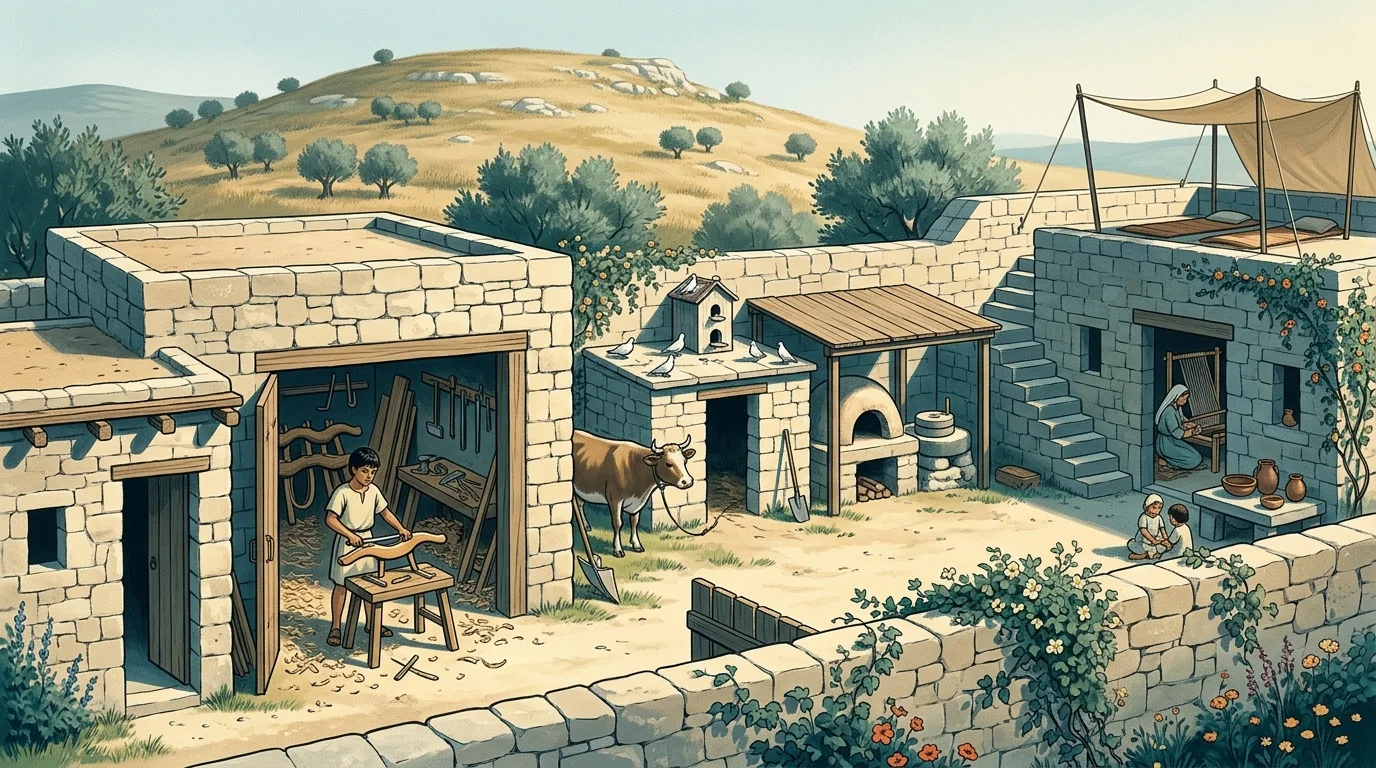
Depicts
Sources
Painted from these passages. Hover a reference to read it.
Accuracy record
Specified by the text
- The home lay near the high hill in the northerly part of Nazareth, on the outskirts, some distance from the village spring in the east of town; south-east of the hill's southern promontory, midway between its base and the road toward Cana (122:6.1)
- A one-room stone house with a flat roof and an adjoining building for the animals; furniture: a low stone table, earthenware and stone dishes and pots, a loom, a lampstand, several small stools, sleeping mats on the stone floor (122:6.2)
- In the back yard near the animal annex, a shelter covering the oven and a two-person grain mill (122:6.2)
- Meals around the stone table from a common pot; a small flat clay olive-oil lamp (122:6.3)
- After Martha's birth Joseph added a large room used as carpenter shop by day and bedroom by night; a small workbench was built for Jesus, who became expert at making yokes (122:6.3, 124:1.7)
- Joseph's separate workshop stood near the village spring and the caravan tarrying lot: yokes, plows, woodwork, leather, rope and canvas (123:1.6)
- Garden walls completely surrounded the home plot, with vines and flowers; the roof was the summer bedroom (123:2.14); back-yard stone stairs led up to a canvas-roofed bedroom (123:4.5)
- Mary kept a dovecote on top of the animal house (123:4.4); the family cow; Jesus learned to weave and was an expert loom operator by ten (123:5.15)
- Cool sea breeze from the west on summer days; dry and rainy seasons only (124:1.10)
- JESUS'S APPEARANCE: a well-nigh perfect child physically (123:2.15); at about 13 his voice began to change (124:5.1); by 18-19 full physical growth, 'a virile and comely youth', eye kind but searching, smile engaging, voice musical but authoritative (127:1.2)
- JESUS'S APPEARANCE: physically strong and robust, a healthy and well-proportioned body (127:1.3); 'one of the most robust and refined specimens of manhood' since Adam, physical development superb (128:6.2)
- JESUS'S APPEARANCE: the usual paintings are 'most unfortunate'; he was not a mild, sweet, gentle mystic; a dignified, natural manhood (141:3.6)
- JESUS'S APPEARANCE: recognizably a Jew by appearance and dress, Galilean by accent (143:5.2); Michael planned to appear as an average man (122:1.3)
- ANCESTRY: Joseph a Hebrew with many non-Jewish strains, lines back through Sumerians, Nodites and the blue man (122:1.1); Mary more a composite of Syrian, Hittite, Phoenician, Greek and Egyptian stocks (122:1.2)
- NOT GIVEN ANYWHERE in Part IV: height, hair colour, eye colour, beard, skin tone
Interpreted
- Scene set about A.D. 6-7, Jesus about twelve or thirteen, at his bench in the new workshop room shaping a yoke
- First-century Galilean house built of local limestone fieldstone with a packed-earth-and-timber flat roof
- Jesus drawn as an average, healthy, sturdy Galilean Jewish boy with olive skin and dark hair, deliberately not idealized
Invented for the picture
- Faces, hair and eye colour of all family members, exact layout of the yard, which siblings are present
Generated with gemini-3.1-flash-image from a brief written against the cited paragraphs.