A receiving world of the outer Havona circuit
Plate 2 of 13 · The Plates of Urantia Wiki
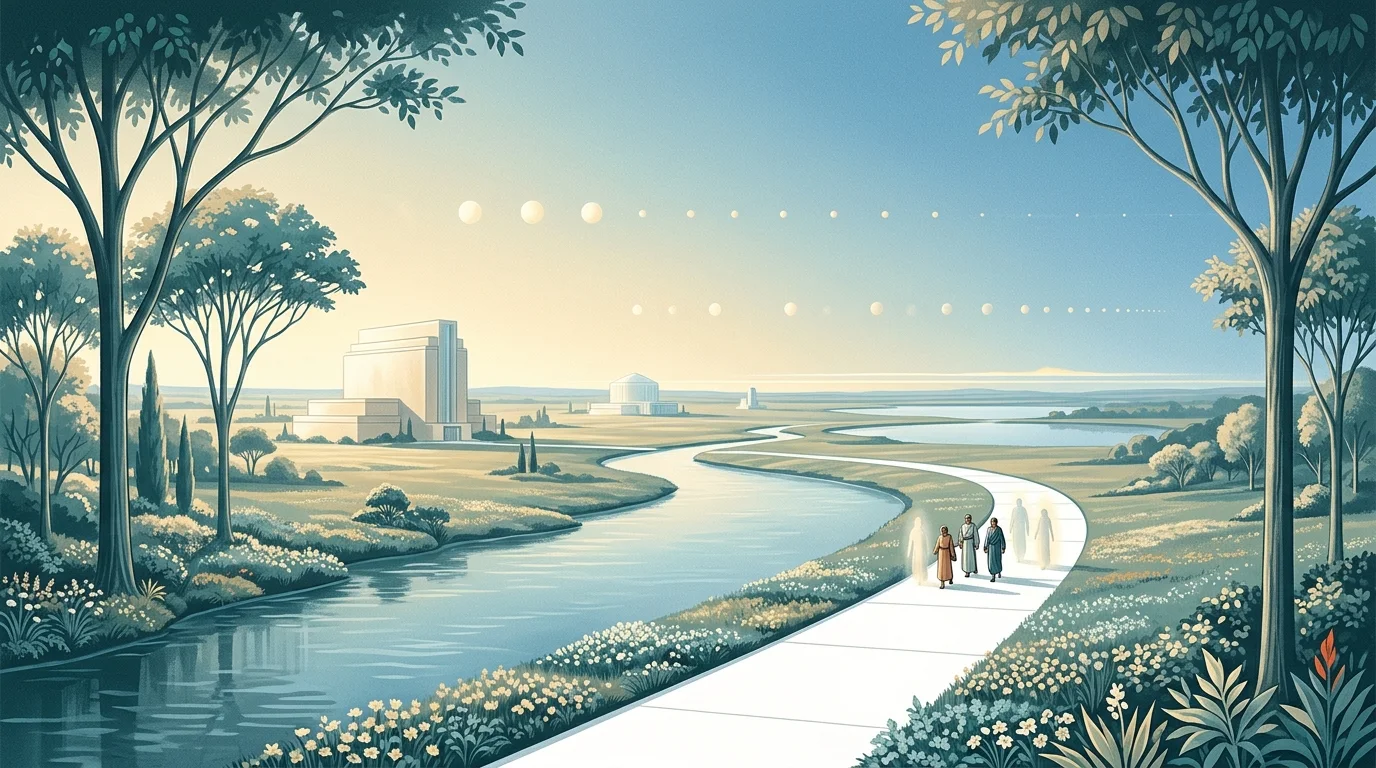
Depicts
Used in
Sources
Painted from these passages. Hover a reference to read it.
Accuracy record
Specified by the text
- Havona worlds are actual, literal material spheres, though of a different energy organization from ours (14:2.1)
- They are enormous spheres, balanced by antigravity and the dark gravity bodies (14:3.6)
- There are real rivers and lakes on these worlds; architecture, lighting, heating and biological and artistic embellishment are beyond human imagination (14:3.7)
- Pilgrims of time are landed on the receiving worlds of the outer, seventh circuit (14:3.4)
- Each sphere is directed by a resident Eternal of Days; no courts or legislatures (14:3.3, 14:3.1)
- Only about one per cent of planetary capacity is in use (14:3.5)
- Decay and death are not part of the cycle of life; lower living things transmute rather than decay (14:4.9)
- Havona natives would be invisible to Urantia mortals (14:2.4); attainment candidates and ascenders are present on every world (14:4.19)
- The Son's seven worlds emit light without heat to the billion worlds (13:0.4)
- Worlds of each circuit follow one another in linear procession in one plane around Paradise (14:1.9-1.10)
Interpreted
- Mostly open, unused parkland with a few great buildings, reflecting the one per cent occupancy
- Visible beings are ascending pilgrims (human-scale, robed); natives shown only as faint luminous presences
- No withered or fallen leaves anywhere, since nothing decays
- Other worlds of the circuit visible as a level row of spheres in the sky; Paradise as a faint distant line of light
- No sun in the sky: illumination taken to come from the Paradise satellites (13:0.4), heatless and even
Invented for the picture
- All architecture, plant forms, colours and the specific landscape; the text explicitly withholds these (14:3.7)
Generated with gemini-3.1-flash-image from a brief written against the cited paragraphs.